

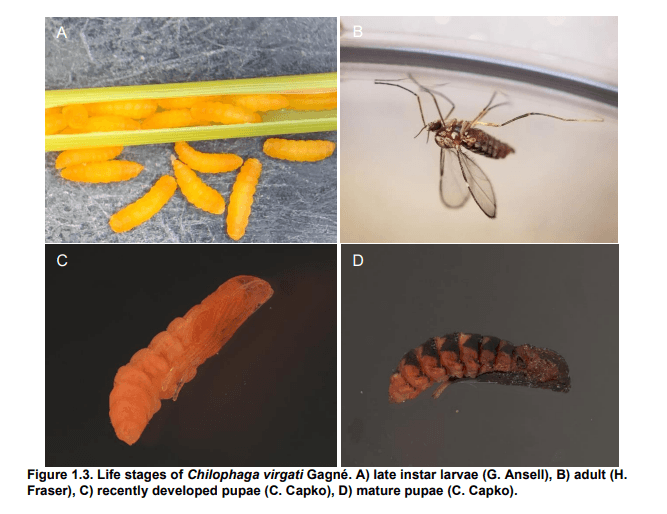
As switchgrass production continues to expand across Ontario, researchers are working to better understand emerging pests that may affect production. Recent University of Guelph research examined the biology, distribution, and yield impacts of the switchgrass gall midge (SGM), a pest first detected in Ontario in 2020. The study, “The switchgrass gall midge (Chilophaga virgati Gagné, Diptera: Cecidomyiidae) in Ontario” focused on understanding the insect’s life cycle, its distribution across Ontario’s switchgrass-growing regions, and the potential implications for biomass and seed production. Previous studies from the United States suggested severe yield losses in heavily infested plants, making it important to determine whether similar impacts could occur under Ontario growing conditions.
The research also provided valuable insights into management strategies. Because SGM overwinters within switchgrass tillers and adults emerge in late spring, removing overwintered material before adult emergence may help reduce populations. Researchers identified approximately 130 growing degree days (base 10°C) as a conservative threshold for removing tillers before pupae begin developing. Additional questions remain regarding the effects of harvest timing, including whether fall harvesting or mid-summer harvests could further suppress populations. Future research will continue to explore these management options while improving our understanding of how environmental conditions and infestation levels influence pest development and crop performance.
The Ontario Biomass Producers Co-op would like to congratulate Clarissa Capko on the successful completion and defence of this important research. We also extend our appreciation to U of Guelph’s Prof. Rebecca Hallett for her guidance and leadership throughout the project. Their work is helping to build a stronger understanding of switchgrass production challenges in Ontario and providing valuable information to support biomass growers and seed producers across the province.
Read abstract below:
Switchgrass gall midge (Chilophaga virgati, SGM) was first detected in Ontario in 2020
on the biomass crop switchgrass (Panicum virgatum). Prior knowledge of SGM biology
was limited to South Dakota, where SGM feeding reduced seed and biomass yields.
The objectives of this study were to determine the phenology of SGM and investigate
factors influencing diapause, determine field infestation levels and yield impacts, and
describe the parasitoid complex associated with SGM in Ontario. SGM was found to be
univoltine with facultative diapause. Timing of diapause initiation was affected by
photoperiod, and the minimum temperature for post-diapause larval development was
11.9–14.5 °C. SGM infestation reduced seed yields, but tiller weight was not impacted.
Parasitism was prevalent and 4 parasitoid species were identified: Platygaster
chilophagae and Trichacis rufipes (both Platygastridae); and Aprostocetus chilophagae
and Quadrastichus sp. (both Eulophidae). This research increases knowledge of SGM
biology and its impact on switchgrass in Ontario
Read full report here